In precision automation, clarity is safety. When you are architecting a multi-axis system, ensuring that the design team, the software controls, and the mechanical assemblers are all speaking the same spatial language is the first step toward project success.
The Standard Framework
While specific application constraints occasionally force design changes, the industry follows a standard convention for defining spatial orientation. We consistently designate the primary horizontal direction as the X-axis, while the Z-axis represents the vertical (or depth) plane, perpendicular to the base. Understanding this fundamental orientation allows engineers to communicate clearly about complex motion paths.
Dictionary of Terms
- X-Axis: The primary horizontal axis of motion. In most Cartesian gantry systems, this represents the longest travel length of the machine base.
- Y-Axis: The secondary horizontal axis, typically perpendicular to the X-axis. In a standard Gantry configuration, the Y-axis usually carries the vertical Z-stage.
- Z-Axis: The vertical axis. This corresponds to the motion perpendicular to the X-Y plane, controlling the "up and down" or depth position of the end effector.
- Theta (θ): Also referred to as "Yaw," this is the rotation about the Z-axis. It defines the orientation of the end effector within the horizontal X-Y plane.
- Tip: The rotation about the X-axis. This motion is often referred to as "Roll" in some coordinate systems; it dictates the angular orientation of the end effector relative to the X-axis.
- Tilt: The rotation about the Y-axis. Often referred to as "Pitch," this movement defines the angular orientation of the end effector relative to the Y-axis.
- End Effector: The specialized tool or gripper mounted to the final axis of the system. This is the component whose position and orientation are defined by the coordinate system above.
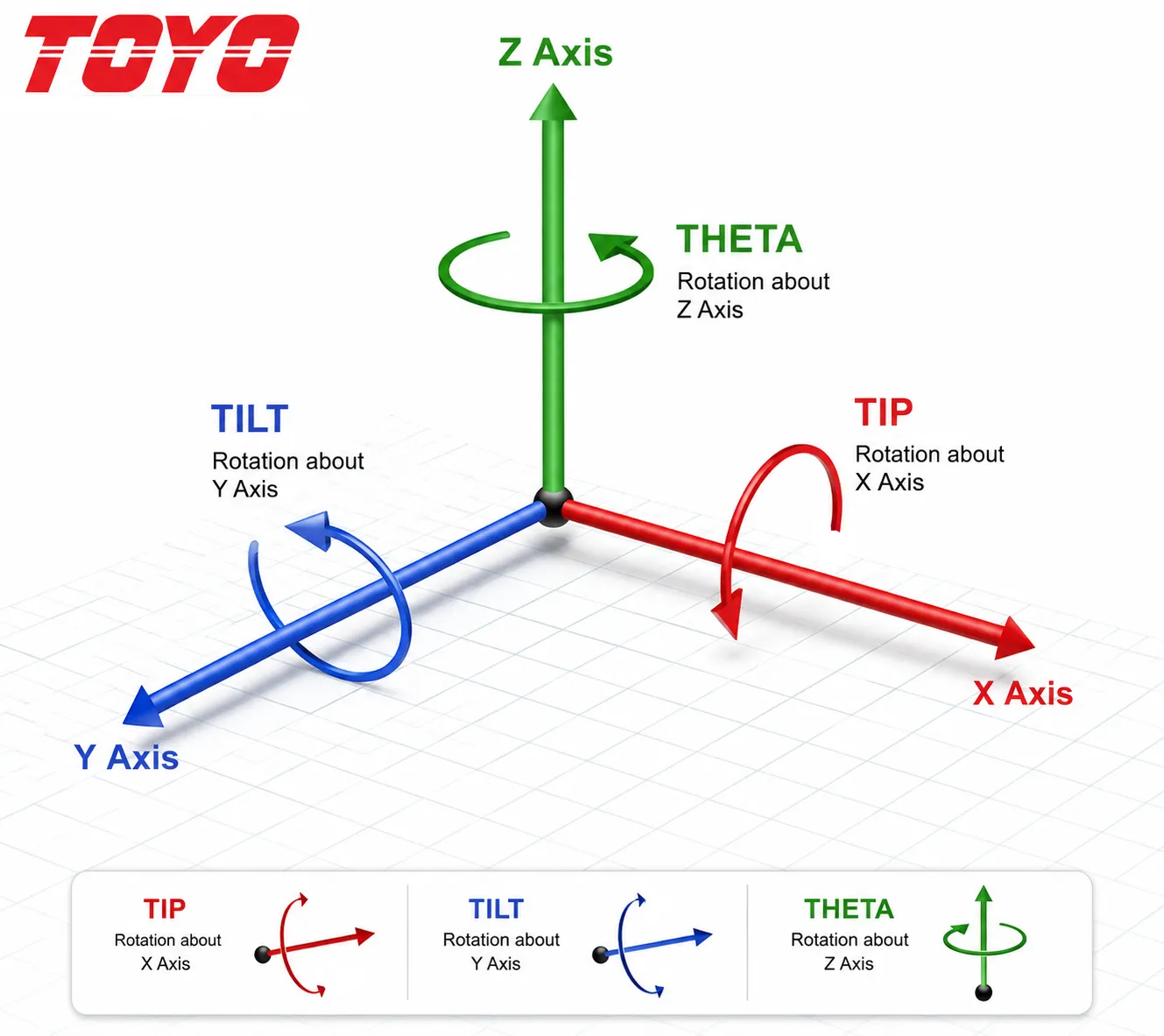
Standard Spatial Orientation
Conclusion
Mastering these definitions ensures that when you specify a motion profile for a multi-axis gantry, the resulting system performs exactly as your engineering calculations intended.