When architecting a linear motion system, the choice between a ball screw and a belt-driven actuator is arguably the most critical design decision you will make. This choice dictates the speed, precision, and physical envelope of your machine. To make the right selection for your application, it is essential to understand the trade-offs between these two fundamental technologies.
Precision and Performance
If your application demands absolute spatial certainty, the ball screw is the industry standard. Ball screw actuators, such as the TOYO GTH Series, are engineered for high-rigidity and steady movement, offering exceptional repeatability often reaching ±0.005 mm or better. They convert rotational force into linear motion with minimal deviation.
In contrast, belt-driven actuators, like the TOYO ETB Series, prioritize high-speed throughput over sub-micron precision. While they offer repeatability generally ranging from ±0.04 mm to ±0.1 mm, they excel in velocity. Belt drives can reach rapid speeds of up to 5,000 mm/s, significantly outpacing the 2,400 mm/s typically seen in ball screw models.
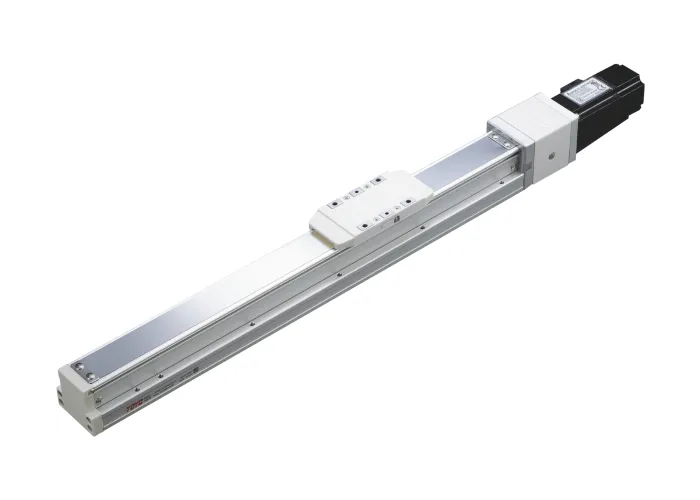
High-Precision Ball Screw
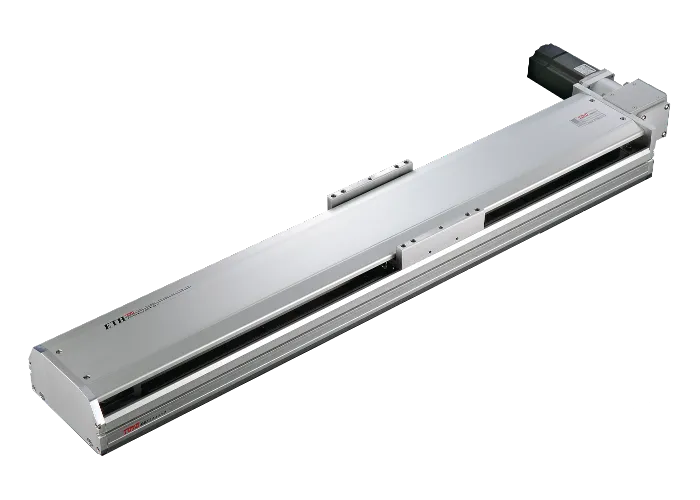
High-Speed Belt Drive
Stroke and Payload Considerations
The physical constraints of your machine often decide the drive type for you:
- Travel Distance: Belt drives are the superior choice for long-distance, high-speed traversals, supporting stroke lengths up to 5,000 mm. Ball screws are generally restricted to shorter distances, though specialized long-stroke variants can push the limit toward 2,400 mm.
- Payload: Ball screws are the workhorses of high-thrust applications, supporting horizontal loads ranging from 5 kg up to 150 kg and higher. While standard belt drives are traditionally reserved for lighter loads, heavy-duty variants—(like the TOYO MK series) can reliably support payloads up to 200 kg.
Lifecycle and Economics
Every drive system has a maintenance profile that must be accounted for in your total cost of ownership:
- Wear and Maintenance: Ball screws provide high mechanical advantage but are susceptible to structural wear in the ball nut and screw threading over long-term, high-cycle use. Belt-driven modules are inherently simpler but require a consistent preventative maintenance schedule, specifically the re-tightening of the belt on an annual basis to ensure consistent tension and accuracy.
- Cost and Design: Belt-driven modules feature a compact design architecture that usually results in lower initial capital costs and reduced assembly time compared to the more complex, higher-precision ball screw assemblies.
Summary Comparison Table
| Feature | Ball Screw (e.g., TOYO GTH) | Belt-Driven (e.g., TOYO ETB) |
|---|---|---|
| Repeatability | ±0.005 mm or better | ±0.04 mm to ±0.1 mm |
| Max Speed | ~2,400 mm/s | ~5,000 mm/s |
| Max Stroke | Up to 2,400 mm | Up to 5,000 mm |
| Thrust Capacity | High / Very High | Medium / Low |
| Primary Advantage | High Precision / Thrust | Speed / Long Distance |
By evaluating your requirements against these metrics, you can ensure that your motion platform is optimized for the demands of your facility—whether that requires the surgical accuracy of a GTH ball screw or the rapid throughput of an ETB belt-driven system.